
Quick answer: To buy native ads online, open an advertiser account with a native ad network, fund it, create a campaign with a goal, targeting, ad creatives, a bid and a budget, then launch it and optimise from the data. Platforms may charge using models such as cost per click (CPC) or cost per thousand impressions (CPM), depending on the platform, campaign type and account, and minimum deposits vary.
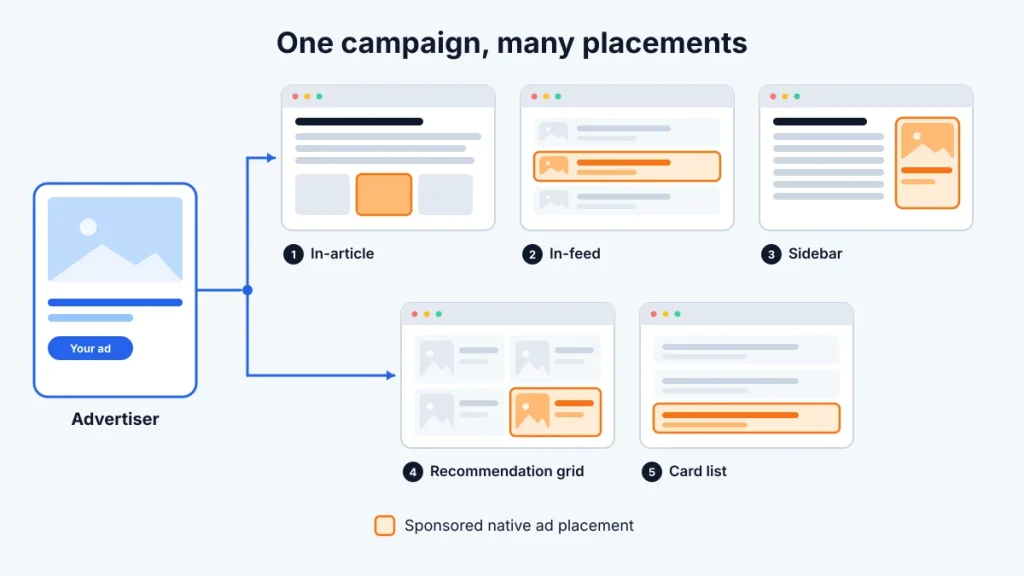
Native ads are paid placements designed to match the look and feel of the content around them, such as a recommended-article widget under a news story or a sponsored tile in a content feed.
Buying them works differently from boosting a social post or running a search campaign. You are rarely paying one publisher for one slot. You usually bid for placements across many websites through a platform that runs the auction, the targeting and the reporting.
This guide covers what you are buying, where to buy it, how to choose a platform, an eight-step launch process, typical costs and how to judge results. Platform details were checked against each provider’s own materials in November 2026. No platform can promise traffic, conversions or a particular return, so the focus is on running a clean first test.
At a glance
- What you buy: the chance to show sponsored content in matching placements across a network of publishers.
- How you pay: it depends on the platform; models such as CPC or CPM are common, often from a prepaid or deposit-based account.
- Where to buy: native ad networks (such as MGID, Taboola and Teads (which combined with Outbrain in 2025)), direct publisher deals, or programmatic and managed services.
- What to track: CTR, CPC, conversion rate, CPA and ROAS.
Last updated: 10 November 2026.
What Does It Mean to Buy Native Ads?
Buying native ads means paying a platform to show your sponsored content (a headline, an image and a link) in placements that match the style of the host page. You create the ad, define who should see it and set a bid and budget. The platform then decides, impression by impression, whether your ad wins a placement.
Native ad platforms may charge advertisers using models such as cost per click (CPC) or cost per thousand impressions (CPM). The available model depends on the platform, campaign type and account. Check the platform’s billing documentation before choosing your budget. Two common models are:
- Cost per click (CPC): you pay when someone clicks your ad. It is a common choice when the goal is driving traffic to a website.
- Cost per thousand impressions (CPM): you pay for every 1,000 times your ad is shown, regardless of clicks. This tends to suit awareness goals.
Some platforms also offer optimisation towards conversions, where the system learns which clicks are most likely to lead to a sign-up or sale. Which options you see depends on the platform and your account.
The important mindset shift is that you are buying audience attention in context, not guaranteed outcomes. You are paying for the opportunity to be seen and clicked, and the quality of your ad, targeting and landing page decides what happens next.
Where Can You Buy Native Ads Online?
You can buy native ads through three routes: native ad networks, direct publisher deals, or programmatic platforms and managed services. The table compares them, and the paragraphs below explain each.
| Route | Best for | Control | Effort and commitment |
|---|---|---|---|
| Native ad network | First-time and self-serve advertisers | Targeting and bids across many sites | Low to medium; self-serve account |
| Publisher-direct | Reaching one specific publication | Fixed placement, sometimes custom formats | Higher; negotiation and commitments |
| DSP or managed service | Larger budgets and complex campaigns | Broad, including programmatic buying | Higher; more complexity and usually higher spend |
1. Native advertising networks. Networks such as MGID, Taboola and Teads (which combined with Outbrain in 2025) connect advertisers with large groups of publishers. You manage everything from one dashboard and reach many sites without negotiating with each. For most advertisers, especially those starting out, this is the practical route.
2. Publisher-direct advertising. Some publishers sell sponsored content or native placements directly. This can give you control over exactly where you appear and sometimes a custom format, but it usually involves negotiation, minimum commitments and a slower process. It makes the most sense when one specific publication reaches your ideal audience.
3. Demand-side platforms (DSPs) and managed services. Larger advertisers may buy native inventory programmatically through a DSP, or hire an agency to run campaigns on their behalf. These options add flexibility and scale, but also complexity and, often, higher minimum spend.
If you are buying native traffic for the first time, start with a network. You can always move to direct deals or programmatic buying once you know what works.
How to Choose the Right Native Advertising Platform
Choose a platform by checking six things: audience fit, targeting, creative rules, pricing, reporting and onboarding. Use this table to compare candidates.
| Criterion | What to check | Why it matters |
|---|---|---|
| Inventory and audience fit | Publishers, countries and languages covered | Your customers must actually read there |
| Targeting | Geography, device, operating system, browser, language, time of day, audience or contextual segments | Controls wasted spend |
| Ad formats and policies | Image specifications, headline limits, restricted categories | Avoids rejections and rework |
| Pricing and minimums | Pricing models offered (such as CPC or CPM), minimum deposit, minimum bids, fees | Sets the cheapest viable test |
| Reporting and tracking | Source or placement reports, conversion tracking, ability to block sources | Lets you cut poor placements |
| Onboarding and support | Self-serve or managed, account review, support access | Affects time to launch |
Snapshot of three commonly considered networks (as of November 2026):
| Platform | Model | What its own materials say | Confirm before you commit |
|---|---|---|---|
| MGID | Self-serve and managed | Pricing documentation describes a prepaid CPC model, a $100 minimum deposit and a recommended initial deposit of at least $650 | Payment methods and account review for your country |
| Taboola (Realize) | Self-serve platform | Realize: Setting Up a New Campaign recommends running a first campaign for at least 7 to 10 days, advises sizing budgets against your target CPA when optimising for conversions, and says ad review can take up to 24 to 48 hours | Minimum deposit, onboarding for your region and the recommendations shown in your advertiser account |
| Teads (which combined with Outbrain in 2025) | Outbrain’s own site describes its performance business as Outbrain Direct Response by Teads, a Teads subsidiary | Outbrain acquired Teads in February 2025 and renamed the company Teads in June 2025 | How advertiser access and minimums work today |
Teads (which combined with Outbrain in 2025): Outbrain acquired Teads in February 2025, and the combined company adopted the Teads name in June 2025. Advertisers researching older Outbrain resources may encounter legacy product names and documentation. Outbrain’s own site describes its performance business as Outbrain Direct Response by Teads, a Teads subsidiary, so check Teads’ current advertiser offerings before signing up.
Registration steps, account requirements and minimums differ between platforms and change over time, so confirm them in each platform’s current advertiser documentation before you commit budget.
For a side-by-side breakdown, see our guide to the best native advertising platforms. It compares the main networks in detail, so you can use this article for the buying process itself.
How to Buy Native Ads Online: Step-by-Step
The interface differs from one platform to the next, but the sequence is almost always the same.
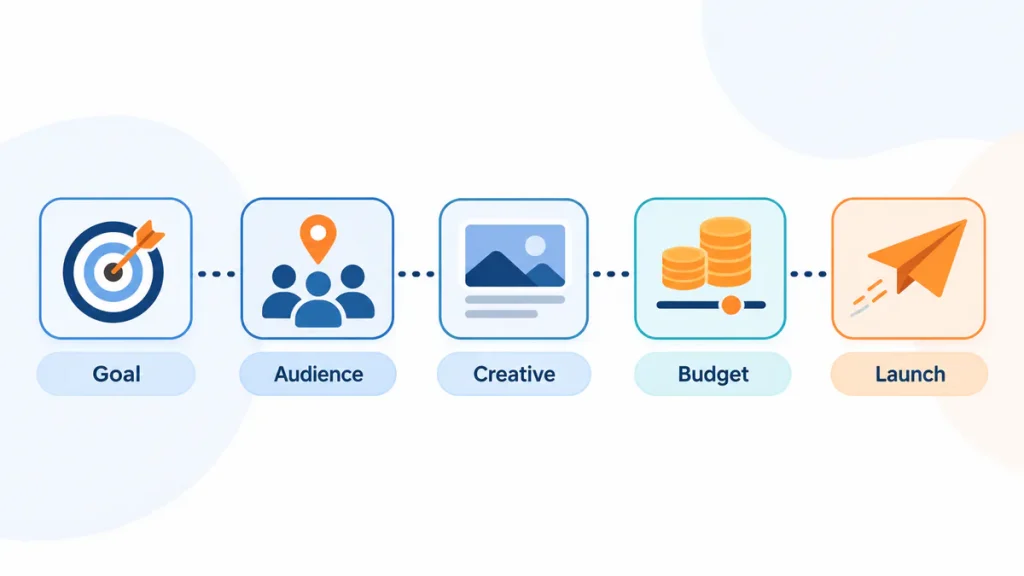
The eight steps in brief:
- Define one clear goal.
- Prepare your landing page and tracking.
- Create and verify your account.
- Fund the account.
- Choose a campaign objective and structure.
- Set your targeting.
- Build your creatives.
- Set bids and budget, then launch.
Step 1: Define one clear goal
Decide what the campaign should achieve before you open an account. Typical goals are website visits, newsletter sign-ups, lead form submissions, product sales or content views. A single goal shapes every later decision: the creative, the landing page, the bid model and the metric you will judge success by.
Step 2: Prepare your landing page and tracking
Native traffic often arrives in a browsing mindset rather than a buying one, so the landing page matters a great deal. It should load quickly on mobile, match the promise made in the ad and make the next action obvious.
Before spending anything, set up tracking. At minimum, install analytics, set up the platform’s supported conversion-tracking method, such as a pixel, tag or server-side integration, and add UTM parameters to your destination URL. Test that a conversion registers. Fixing tracking after you have spent your budget is expensive.
Step 3: Create and verify your account
Sign up on your chosen platform’s advertiser page. Expect to provide business details, a website and contact information. Some platforms approve self-serve accounts quickly; others review the site first or ask you to speak with a representative. Requirements differ by platform, so follow the current instructions on each one.
Step 4: Fund the account
Most networks work on a prepaid or deposit basis, though some offer billing arrangements for established advertisers. Check the minimum deposit, accepted payment methods and any tax or fee implications. Add enough to run a proper test, not just a handful of clicks.
Step 5: Choose a campaign objective and structure
Select the objective that matches your goal from Step 1 (traffic, conversions or awareness, depending on what the platform offers). Keep the first campaign simple: one objective, one landing page and a small number of ad variations. A tidy structure makes the results easier to read.
Step 6: Set your targeting
Start broad enough to give the platform room to learn, but not so broad that you pay for irrelevant audiences. Sensible first decisions include:
- Location: target only regions you can serve.
- Device and operating system: mobile and desktop users often behave differently, so consider separate campaigns if your landing page treats them differently.
- Language and time of day: match your audience and your ability to respond to leads.
- Interest or contextual segments: use them where the platform offers them, but avoid stacking so many filters that delivery dries up.
Step 7: Build your creatives
The image and headline do nearly all the work in native advertising. Use these principles:
- Headlines: be specific and clear, and make sure the page delivers what the headline suggests. Sensational or misleading headlines may be rejected and tend to attract low-intent clicks.
- Images: use sharp, uncluttered images that suit the content style of the host site. Avoid heavy text overlays, and check each platform’s image specifications and policies.
- Variations: upload several image and headline combinations so the platform can show you which pairings people respond to.
Here is a complete ad concept for a business selling accounting software to freelancers:
- Headline: How Freelancers Can Track Invoices and Expenses in One Place
- Image: a clean, screenshot-style illustration of an invoice and expense dashboard
- Destination: a landing page explaining the software’s features
- Call to action: Learn More
A vague headline such as “Transform Your Finances Today” says little, while this one tells the reader exactly what they will get and who it is for.
Step 8: Set bids and budget, then launch
Choose a daily budget you are comfortable spending even if the first results are disappointing. Set your bid according to the platform’s guidance, remembering that very low bids may win little traffic. Submit the campaign for review. Approval can take from a short time to a day or more, depending on the platform and your content.
Once approved, resist the urge to change things every hour. Early data is noisy, and making many edits at once makes it impossible to tell what caused any change.
How Much Does It Cost to Buy Native Ads?
Native ads have no fixed price: cost depends on your pricing model, audience location, industry, competition, creative quality and the platform’s minimum deposit. MGID’s documentation, for example, lists a $100 minimum deposit, while the cost of each click or impression varies by market and by auction.
The factors that matter most:
- Pricing model: where a platform offers them, CPC campaigns charge per click and CPM campaigns charge per thousand impressions.
- Minimum deposit and bids: these are set by each platform and can differ by region, so check the current advertiser documentation. MGID, for example, lists a $100 minimum deposit and recommends at least $650 for testing, while Taboola advises sizing budgets against your target CPA.
- Geography: audiences in some countries cost considerably more to reach than in others.
- Competition: crowded industries and busy seasons push prices up.
- Creative quality: ads that earn more engagement can often be delivered more efficiently.
A simple way to plan a test budget is to work backwards from what you need to learn. The numbers below are hypothetical, for arithmetic only, and are not benchmarks:
Suppose you set aside $600 for a one-month test, which is $20 per day. If clicks cost $0.30 on average, that buys about 2,000 clicks. If 2% of visitors convert, that is about 40 conversions, or roughly $15 per conversion. If a conversion is worth less than that to your business, you will need to improve the ad, the landing page or the offer, or reconsider the channel.
Your actual cost per click and conversion rate may be very different, and platform-recommended minimums may be higher than this example, so check them before settling on a budget. The point of the exercise is to know, in advance, how many clicks you need to get a meaningful read and whether the economics could plausibly work.
How to Track and Optimise Native Ad Campaigns
Track five core metrics, CTR, CPC, conversion rate, CPA and ROAS, and interpret them together, alongside placement and conversion data.
| Metric | Formula | What it tells you |
|---|---|---|
| Click-through rate (CTR) | Clicks ÷ impressions × 100 | Whether the headline and image attract attention |
| Cost per click (CPC) | Spend ÷ clicks | What each visit costs |
| Conversion rate | Conversions ÷ clicks × 100 | Landing page and traffic quality |
| Cost per acquisition (CPA) | Spend ÷ conversions | What each result costs |
| Return on ad spend (ROAS) | Revenue ÷ ad spend | Revenue per unit of spend, when conversions have a value |
No single metric tells the whole story. A campaign with a high CTR can still bring poor-quality traffic, so compare each metric with placement-level and conversion data before changing bids or creatives.
For a refresher on how these measures fit together, read our overview of PPC campaign metrics.
Optimisation follows a straightforward pattern:
- Low CTR: test new headlines and images.
- Good CTR but few conversions: look at the landing page, the offer and whether the ad promise matches the page.
- Uneven source quality: review the platform’s placement or publisher reports. Pause or block sources that spend without converting, and increase bids on sources that perform.
- Enough data to decide: let each variation collect a reasonable number of clicks before judging it, and change one element at a time.
Native traffic often influences people who convert later, not just immediately. If your sales cycle is longer, consider looking at assisted conversions and view-through activity in your analytics, in addition to last-click results.
Common Mistakes to Avoid When Buying Native Ads
| Mistake | Why it hurts | Fix |
|---|---|---|
| Starting without tracking | You cannot tell which clicks produce results | Set up the platform’s supported conversion tracking, add UTM parameters and test a conversion before launch |
| Targeting too broadly or too narrowly | Broad targeting wastes budget; too many filters starve delivery | Start with location, device and language, then refine |
| Clickbait headlines | Low-intent clicks, high bounce rates and ad rejections | Make the headline match what the page delivers |
| Sending traffic to a generic homepage | Visitors lose the thread of the ad | Use a page that continues the ad’s story |
| Judging results too early | Early data is noisy | Wait for a meaningful number of clicks per variation |
| Ignoring placement reports | Poor sources quietly absorb budget | Review sources; pause or block those that do not convert |
| Ignoring platform policies | Rejections and wasted time | Read the advertising policies before building creatives |
| Changing everything at once | You cannot tell what worked | Change one element at a time |
Frequently Asked Questions
How can I buy native ads online?
Create an advertiser account with a native advertising network, fund it, set up a campaign with a goal, targeting, creatives, a bid and a budget, then submit it for review. Once it is approved, monitor performance and optimise.
Where can I buy native advertising traffic?
The most common route is a native ad network such as MGID, Taboola or Teads (which combined with Outbrain in 2025). You can also arrange sponsored placements directly with individual publishers, or buy through a demand-side platform or an agency.
Which platform is best for buying native ads?
It depends on your goal, budget, region and audience. Compare inventory, targeting, minimum spend, creative requirements and reporting. Our guide to the best native advertising platforms compares the main options.
How much money do I need to start native advertising?
That varies by platform, region and account type. Check each platform’s minimum deposit, then budget enough to collect a meaningful amount of data, not just to launch. For example, MGID’s documentation lists a $100 minimum deposit and suggests at least $650 for testing, while Taboola ties budgets to your CPA target. Always confirm current figures in the platform’s advertiser documentation.
Can small businesses buy native ads?
Yes. Many networks offer self-serve accounts that let smaller advertisers run campaigns. Smaller budgets simply mean you should keep targeting focused, test fewer variations and be patient while collecting data.
What is the difference between native ads and display ads?
Display ads are typically standard banner formats that look distinct from the page. Native ads are designed to match the format and style of the content around them, such as recommended-content widgets or in-feed units. Native placements are usually labelled as sponsored.
How do I measure the performance of native ad campaigns?
Track CTR, CPC, conversion rate, CPA and, where revenue is measurable, ROAS. Use conversion tracking and UTM parameters so you can connect platform data with what happens on your site.
Key Takeaways
- Start with a native ad network; consider direct deals or programmatic buying once you know what works.
- Set one goal, and prepare tracking and a landing page before spending.
- Fund the account, build a focused campaign and launch with several creative variations.
- Check minimum deposits and policies in each platform’s current documentation.
- Judge results by CTR, CPC, conversion rate, CPA and ROAS, and change one element at a time.
A practical next step is to shortlist two platforms from our best native advertising platforms guide, check their current minimum deposits and policies, and plan a small, well-tracked test campaign. If you would rather have specialists set it up and manage it, get in touch with Harmukh Technologies to discuss a native advertising test for your budget.